
Practical Strategies for Healthy Body Composition
If you have been reading our series on defining and achieving Physical Health over at the Becoming a High Impact Human substack channel, you have a pretty good idea of the frameworks you can consider to build your own philosophy of physical health. And now you know how Sarah’s personal experience, training, and coaching so far have informed her thinking about how to frame and assess physical health. What should you do if you want to improve your own physical health?
Sarah’s take:
Have a clear goal. Why do you really want to achieve? Longevity? Strength? A specific aesthetic? Most people want to look and feel good, but they think those are the same thing. They are not. You don’t have to pick between them, but you do need to know your real goal(s). If you want to look slimmer or fit in pants from 15 years ago, getting stronger should be a waypoint that shows you progress and you should see it as such rather than “still not being ______.” You can only do that if you know what your goal really is.
Find out what’s going on in your body. Get a body composition measurement from a bioimpedance scale, a BodPod, or an InBody scanner (note that the bioimpedance scale is something you can get for $50-$200 and keep in your bathroom; BUT the leaner you are, the less accurate it will be–in my case, there is a 6% difference in body fat percentage measurement from In Body to my at home Renphro scale, and that led to a lot of frustration before I realized my measurements were losing accuracy as my body fat declined below 18%). Also consider using something like Function Health, Emerical or Whoop to get twice per year blood tests of key blood markers to evaluate whether your diet, exercise, and recovery practices are serving you well. Those are typically $150-200 per round of tests and you do not need a physician order.
Use your body composition to set your daily protein target. Unless you have kidney issues, your protein consumption should be .8-1.2 (average person) to 2.2 (athlete) grams of protein per pound of target lean body mass per day (I want to maintain 85 pounds of skeletal muscle, so I get 187 grams of protein per day; if that sounds like a lot, it is). Use your average daily activity to find your target daily caloric intake, which should be a multiple of your basal metabolic rate (you can get this from your body composition measurement–check the app for in-home scales, or look at the readout from InBody, BodPod or the like). Many online calculators are available, but they often overestimate needs for sedentary people and underestimate needs for more active people. Here is general guidance for a starting point, but you will need to track and adjust if you want to achieve ideal body composition!
You are mostly sedentary and exercise <3 times a week for < 1 hour: BMR x 1.2
You are mostly sedentary but exercise intensely >3x/week, for >1 hour: BMR x 1.4
You are moderately active and exercise <3 times a week for < 1 hour: BMR x 1.3
You are moderately active and exercise intensely >3x/week, for >1 hour: BMR x 1.6
You are highly active and exercise <3 times a week for < 1 hour: BMR x 1.8
You are highly active and exercise intensely >3x/week, for >1 hour: BMR x 2
Now that you have your total daily calorie target, set your protein, carbohydrate, and fat goals:
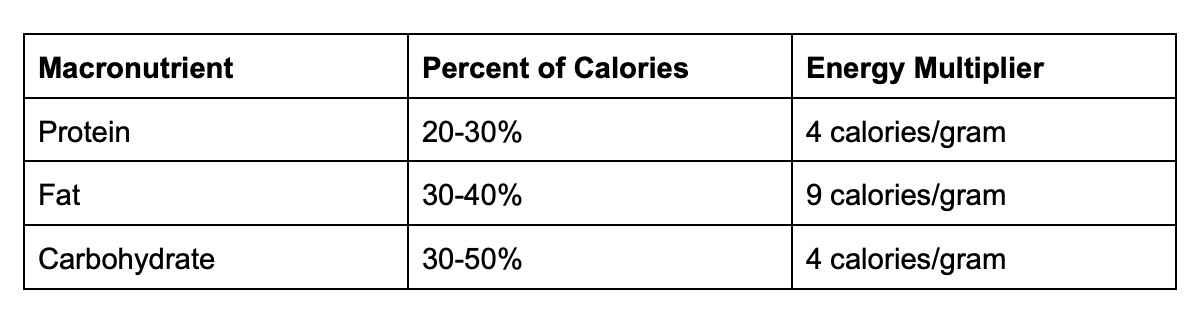
Setting macronutrient targets and calculating total calories per macronutrient group
This means if you are targeting 180 grams of protein and you are moderately active and exercise five days a week, you have (for example) a BMR around 1800 and a multiplier of 1.5. Your total target calories are 2,700 to maintain body weight. Protein will take up 720 of those calories (180x4), which is 26% of your total. The balance will go to carbs; let’s say 44% of your diet, which is 1,188 calories or 297 grams of carbohydrates per day (that's 1,188/4). The remaining amount is 2700-720(protein)-1188(carbs) = 792 calories, or 88 grams of fat (that’s 792/9), which is 30% of your total calories. So your eating targets are:
Protein: 180 grams
Carbs: 297 grams
Fat: 88 grams
Make sure every day includes eating whole foods aligned to your targets–and hit your protein targets daily. How do you know how much? You track it. At least for a while. Why track it and not just eat intuitively? Funny you should ask. Last year, I spent the first quarter of the year being somewhat disciplined and the second quarter being intensely disciplined around eating and working out because I was training for a major event. The event preparation and the event itself left me feeling burned out with an overwhelmed gut. I went into the event at a weight of 169 pounds with 13.7% body fat and about 83.8 pounds of muscle. I decided to drop all eating rules and stop tracking any food for the rest of the year (about 5 months) and instead eat intuitively.
Even though I had been in the habit of consuming between 160 and 200 grams of protein per day for the prior seven months, my natural eating shifted quite a bit. There were environmental factors in play (e.g., I have four little kids who never finish their food so I was eating more foods that I usually don’t, like pizza, pasta, and dino nuggets). After five months, I weighed .2 pounds less but my muscle dropped to 79.8 pounds (-4 pounds of hard earned muscle!!!) and my fat mass increased from 23.1 to 29.5 pounds (+6.4 pounds of fat…ugh). That’s back up to 17.4% body fat.
Fortunately, less than one month later, I made a shift back to 82.2 pounds of muscle and 26.3 pounds of fat, with a total body weight of 170.3–just by going back to my target protein macros. Without reducing my calories, I dropped to 15.5% body fat. So: track protein. You ought to track everything so you understand what you’re eating but if you really hate that, the “hack” is to track protein and hit your targets every day.
Optimize your exercise to build more muscle. You don’t have to get jacked (although it’s fun to be strong and to regularly push your capacity, which keeps going to the gym interesting). You can get a lot done with bodyweight exercise. My fellow firefighter and I made a technique video with bodyweight exercises and he got a great workout. Adding weights, which do not need to be heavy, will increase your muscle synthesis and improve your neuromuscular control. I’ll offer more ideas for basic workouts over the next few weeks.
